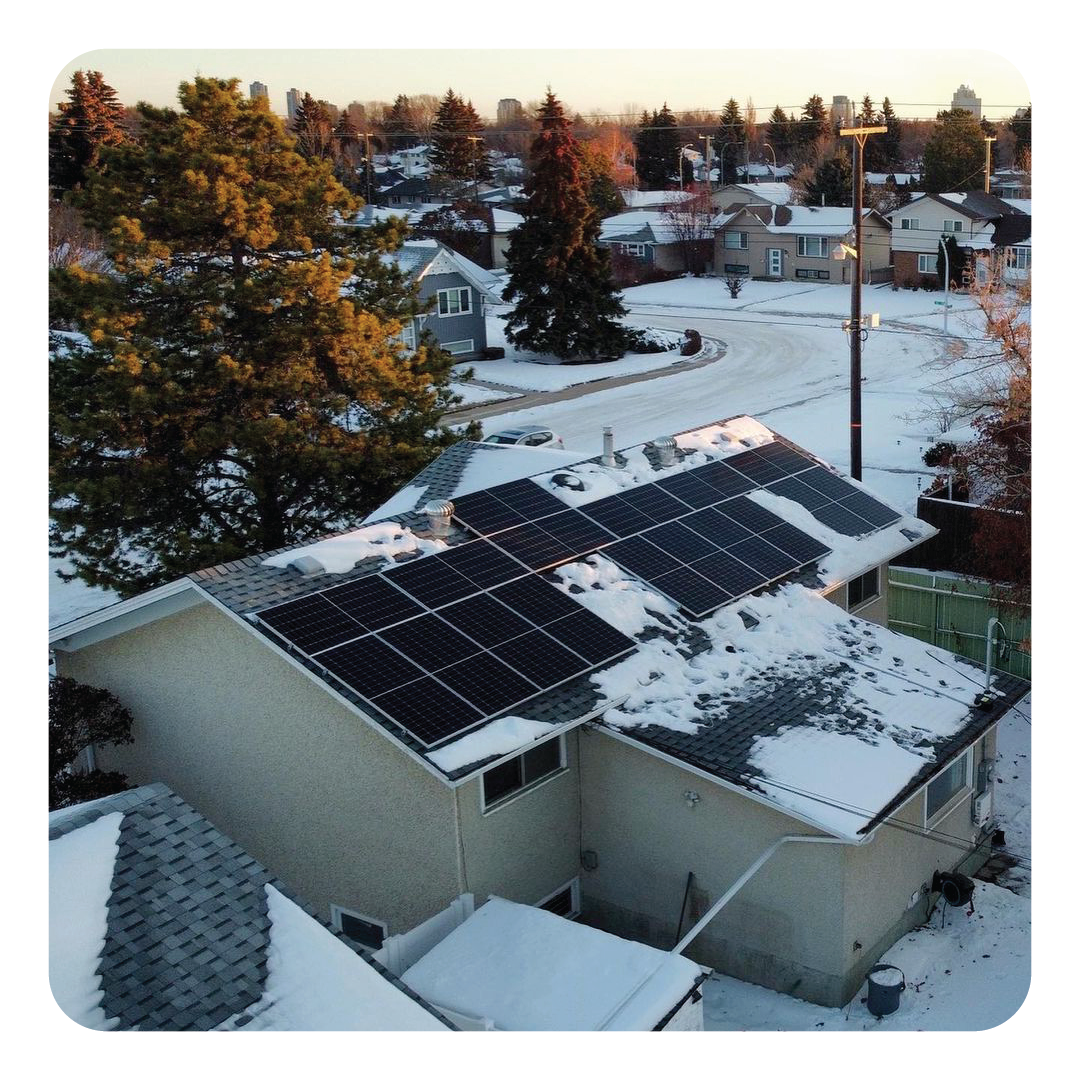
Most confusion about solar in Alberta comes down to a few persistent misconceptions. These aren't just minor misunderstandings. They lead people to either overestimate what solar can do or dismiss it based on the wrong criteria. Here are three reframes that usually clear things up.
1. You're not generating power to sell. You're reducing a bill.
A lot of people approach solar thinking about it as a generation business, as if the goal is to produce as much electricity as possible and get paid for it. That framing leads to disappointment because export rates in Alberta aren't high enough to make generation for profit work.
The correct frame is bill reduction. Your solar system offsets electricity you would have purchased at retail rate, currently around 18 cents per kWh all-in in Alberta. Every kWh your panels produce is a kWh you didn't have to buy. When you think about it that way, the math is straightforward: how much electricity does your home use, how much will a given system produce, and what does that offset cost savings add up to over 25 years?
For a typical Alberta home using 12,000 kWh per year at 18 cents, that's $2,160 in annual electricity purchases. A well-sized system that covers 80% of that usage saves $1,728 per year, growing as rates increase. That's the real number, and it's a compelling one.
2. The break-even math works at current rates, even without escalation.
One hesitation we hear often is something like, "But what if electricity rates drop?" It's worth running the scenario. Alberta's average all-in electricity rate has increased at roughly 2 to 3% annually over the last decade, but even if we assume zero escalation from here, a $25,000 solar system saving $1,800 per year breaks even in about 14 years on a 25-year system. Every year after that is pure savings.
When you account for historical escalation trends, break-even moves to 11 to 13 years and lifetime savings on an 8 kW system exceed $45,000 in most Edmonton-area scenarios. You're essentially buying 25 years of electricity at a fixed cost instead of watching your utility bill grow indefinitely.
3. CEIP changes the monthly math more than the total cost math.
CEIP is valuable, but not primarily because it makes the system cheaper over time. The interest rate is 3.75%, so you pay a financing cost over 20 years. What CEIP really does is change the month-one cash flow picture.
Without CEIP, you pay $25,000 upfront or finance at a higher rate, which means your monthly payment is often higher than your monthly electricity savings in the early years. With CEIP at 3.75%, many homeowners find that the monthly tax addition is lower than the monthly electricity savings from day one, so the system is cash-flow positive from the first payment.
Whether or not CEIP is available in your city, the 25-year economics are similar. CEIP is about cash flow, not total outcome. That's useful to understand when deciding whether to wait for a CEIP window to open or to proceed with conventional financing.
Ready to See the Numbers for Your Home?
Get a free site-specific estimate with projected savings, financing options, and break-even timeline, no pressure, no obligation.