Your Alberta Solar Estimate: What's Actually Included
A professional solar proposal is more than a price tag. It's a complete financial roadmap showing exactly what solar does for your specific home, your utility, your incentive eligibility, and your long-term electricity costs. Here's what ours includes.
What We Need From You
An accurate solar estimate starts with accurate inputs. The single most important piece of information is your electricity bill. Ideally we want at least 3 months of usage data, and ideally 12 months, so we can size a system to match your actual annual consumption pattern rather than a generic household average.
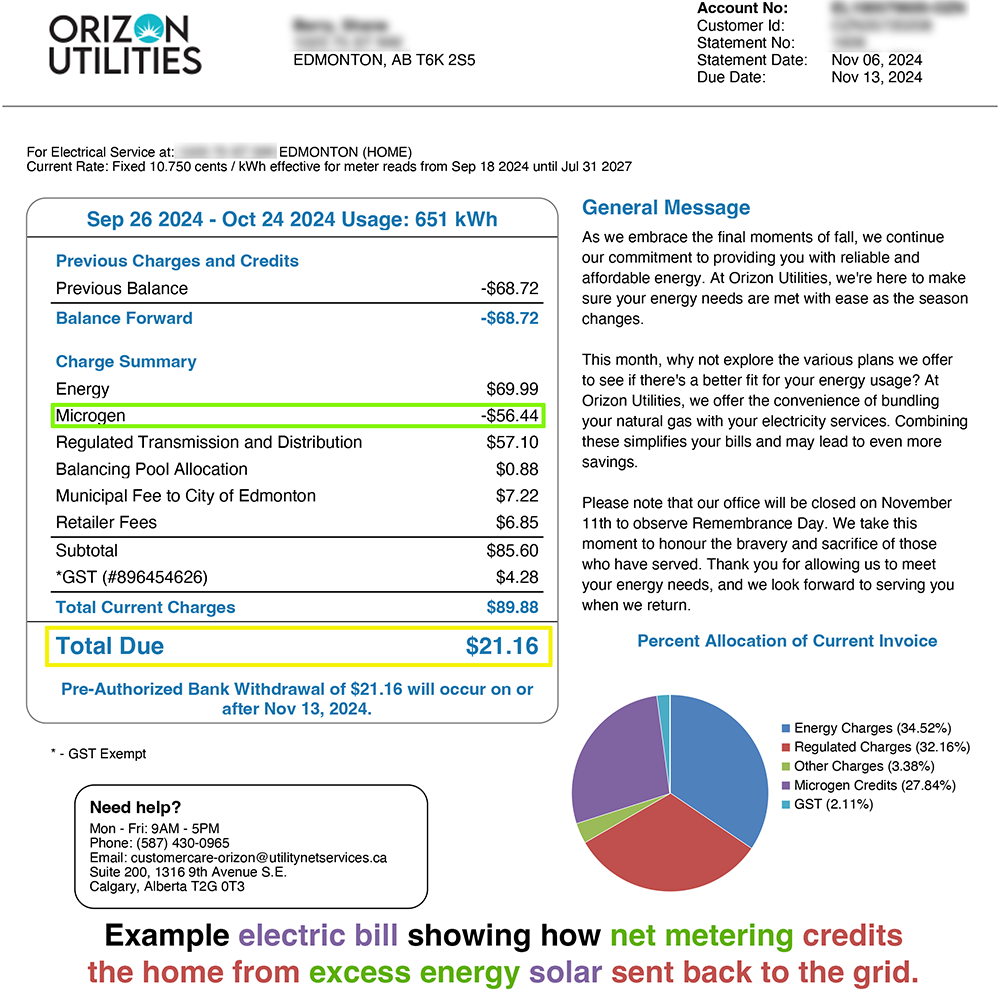
From your electricity bills, we determine your average monthly kWh usage, your peak summer and winter consumption, which utility distributes your power (EPCOR, FortisAlberta, ATCO, ENMAX, or municipal), and what rate plan you're currently on.
We also consider future energy needs. Are you planning to add an electric vehicle? A heat pump? A hot tub? These changes meaningfully affect how much solar you'll want, and a system sized for today may leave savings on the table tomorrow. Your estimate accounts for where your energy needs are heading, not just where they are now.
10 Things Inside Your Solar Proposal
A serious solar proposal answers every question you didn't know to ask. Here's exactly what ours covers:
Custom System Size Based on Your Usage
We size your system to your actual annual consumption, not a generic Alberta average. This means we're targeting a real offset percentage (typically 85-100% of annual usage) based on your specific bills. Over-sizing wastes money; under-sizing leaves savings uncaptured.
Equipment Options: Panels, Inverters, and Mounting
We present you with equipment tiers, not just one option. Panel choices typically include options from tier-1 manufacturers in the 400-430W range. Inverter options span string inverters (cost-effective for simple roofs) and microinverters or power optimizers (ideal for shaded or complex roofs). We explain the tradeoffs in plain language.
Shade and Production Analysis
Using satellite imagery and solar path modelling, we assess your roof's annual solar access, factoring in trees, chimneys, neighboring structures, and seasonal sun angles. You'll see realistic production numbers by month, not just an annual total that hides seasonal variability.
Incentive Eligibility by Postal Code
Based on your address, we identify every incentive you may qualify for: CEIP program availability and current interest rate for your municipality, Solar Club eligibility based on your distribution utility, federal Investment Tax Credits for qualifying homeowners or businesses, and any active municipal or provincial rebates. We track program status across 27+ Alberta municipalities.
Financing Comparison: CEIP, Cash, and Private Loans
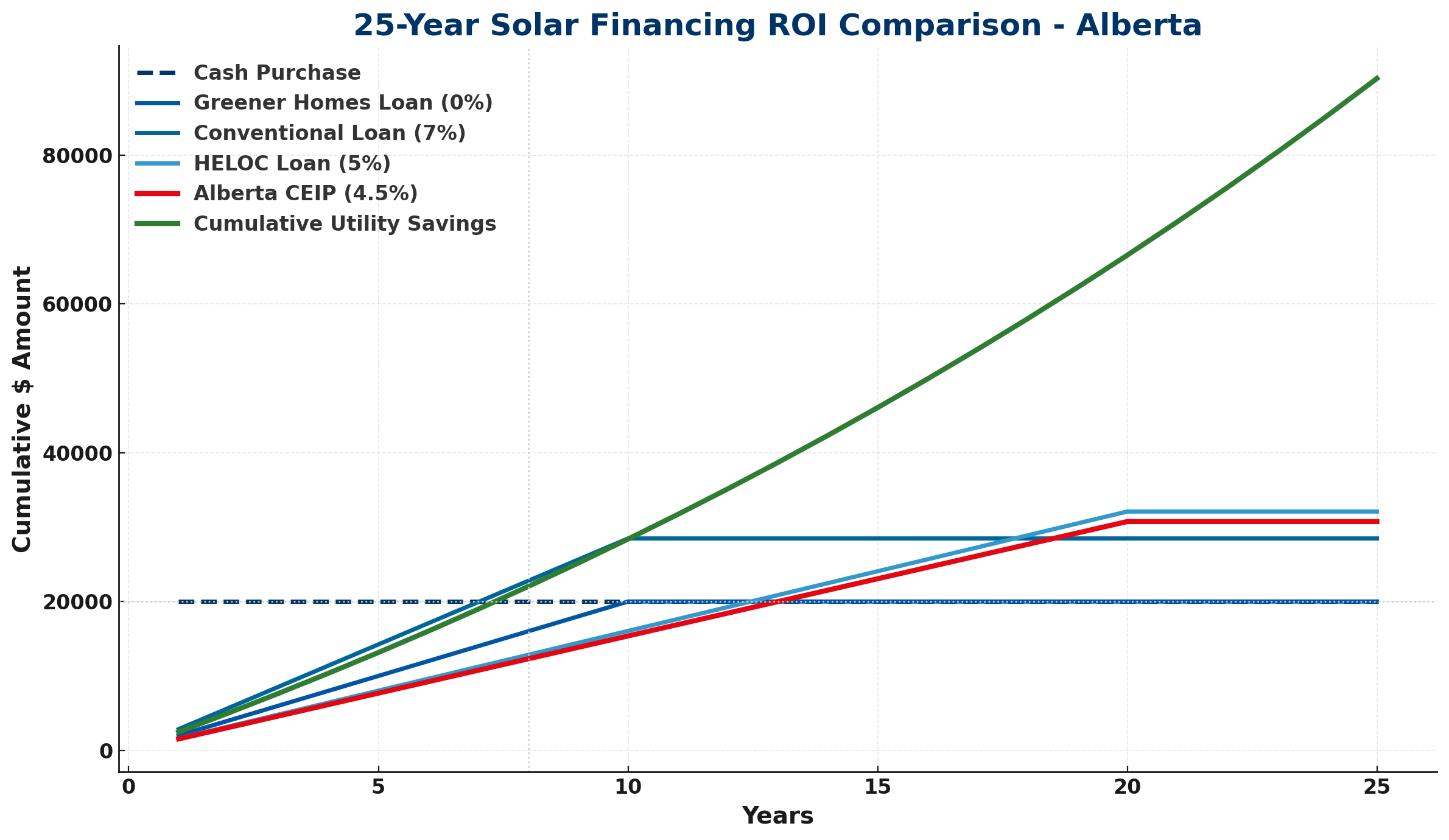
We model your numbers across multiple financing scenarios side by side: cash purchase (best long-term ROI), CEIP loan (no upfront cost, repaid on property tax), and private solar financing (fixed monthly payment, often similar to CEIP). You see monthly cost, payback period, and lifetime savings for each option so you can make an informed choice.
Monthly, Annual, and Lifetime Savings Projections
You'll see what your electricity bill looks like month by month after solar, accounting for seasonal production swings and your consumption patterns. Annual savings are shown for years 1-25. Lifetime savings factor in a conservative electricity rate escalation assumption (typically 2-3% per year) so you can see how the value of your investment grows as grid rates rise.
Break-Even Year and ROI
Your exact break-even year is calculated based on your system cost, financing choice, actual estimated savings, and rate escalation assumption. We show you the cumulative savings curve so you can see when the investment crosses into profit. We also show you the cost of not going solar: the total you'll spend on electricity over 25 years if nothing changes.
Roof Condition and Main Panel Assessment
Solar panels last 25-30 years. If your roof is 15+ years old, we discuss timing and whether it makes sense to re-roof before or alongside installation. We also assess whether your main electrical panel can support the solar system or if an upgrade is required, which affects total project cost and timing.
Warranty and Performance Guarantees
We explain what's covered and for how long: panel performance warranties (typically 25 years at 80%+ output), product warranties (25 years on most tier-1 panels), inverter warranties (typically 10-25 years depending on type), workmanship warranty from the installing contractor, and how warranty claims are handled.
Energy Efficiency Opportunities
Solar is the biggest single lever for reducing your electricity bill, but it's not the only one. Your proposal may include notes on other efficiency measures, such as LED lighting, smart thermostats, programmable EV charging to maximize solar self-consumption, or heat pump opportunities, that can further reduce your bills and improve solar ROI.
Why the Proposal Review Matters
Our installers conduct proposal reviews in person or over a video call. This is where numbers become real. You can ask every question you have about the system design, the equipment choices, the incentive applications, the installation timeline, what happens if a panel underperforms, and what the monitoring system looks like day-to-day.
A review call typically runs 30-45 minutes. By the end, you should know exactly what you're buying, what it costs, what it saves, and when it pays for itself. If it doesn't make sense for your home, we'll tell you that too. There is no pressure to sign. The estimate is free regardless of your decision.
We've found that homeowners who go through a thorough proposal review make better decisions, have more realistic expectations, and are more satisfied with their systems long-term.
What Makes Our Estimates Different
Real numbers, not averages
Every estimate is built on your actual electricity bills and your specific roof. We don't use provincial averages that might be off by 40% for your home.
Fact-checked incentives
We track CEIP status across 27+ municipalities and update our incentive data when programs open, pause, or change rates. You get current information, not stale data.
Side-by-side financing
We show you cash, CEIP, and private financing on the same page so you can compare lifetime costs and monthly payments before deciding. No hidden agendas toward any financing product.
Honest break-even timelines
We use conservative assumptions. If your break-even is year 13, we'll say year 13, not year 9. Accurate projections mean you're not disappointed by reality.
Future-proofed sizing
We ask about EVs, heat pumps, and future home upgrades. A system sized for today that's too small for next year's EV is a missed opportunity.
No pressure, ever
Our team doesn't work on commission. Your proposal is yours to review, compare, and decide on in your own time. We're here to answer questions, not close deals.
How to get your estimate in three steps
Fill out our short form
We ask about your home, utility, and electricity usage. Uploading 3-12 months of bills gives us the best accuracy, but we can start with less.
We build your custom estimate
Our team models your system size, production, incentives, financing options, and savings across multiple scenarios. This usually takes 1-2 business days.
Review with an advisor
We walk through your proposal in person or on a video call and answer every question. No obligation to proceed.
Solar Estimate FAQ
Yes, completely free with no obligation. We don't charge for proposals and there's no obligation to proceed. We provide estimates to every homeowner who fills out our form, regardless of whether they end up installing.
Ideally 12 months, which gives us your full seasonal production and consumption pattern. We can work with as little as 1-3 months but the sizing accuracy improves with more data. If you don't have your bills, we can often look up your usage history from your utility account.
Solar works on asphalt shingle, metal, clay tile, and most other roof types. The key factor is age and condition. If your roof has significant life remaining (10+ years), installation can proceed normally. If it's older, we'll discuss the tradeoffs of re-roofing now vs. later. Roof replacement is much easier to do before solar is installed than after.
Many homes with 100A or older panels require an upgrade to 200A before solar installation. We assess this during the proposal process and include any panel upgrade costs in the total project cost so there are no surprises. Panel upgrades typically cost ,000-,500 depending on your current setup.
From signed proposal to system activation, most Alberta residential installations take 8-14 weeks. This includes permit application (1-3 weeks), equipment procurement (2-4 weeks), installation (1-2 days), electrical inspection (1-2 weeks), and utility interconnection and meter swap (3-6 weeks depending on your utility).
Yes. We provide estimates for commercial buildings, warehouses, multi-family properties, and agricultural operations. Commercial proposals include additional analysis for CCA Class 43.2 tax deductions and the 30% federal Investment Tax Credit, which significantly improve commercial solar economics. See our commercial solar page for more details.
Get your free Alberta solar estimate today
Fill out our short form to get started. We'll model your home against your actual electricity bills, identify every applicable incentive, and give you a transparent proposal with no pressure to proceed.